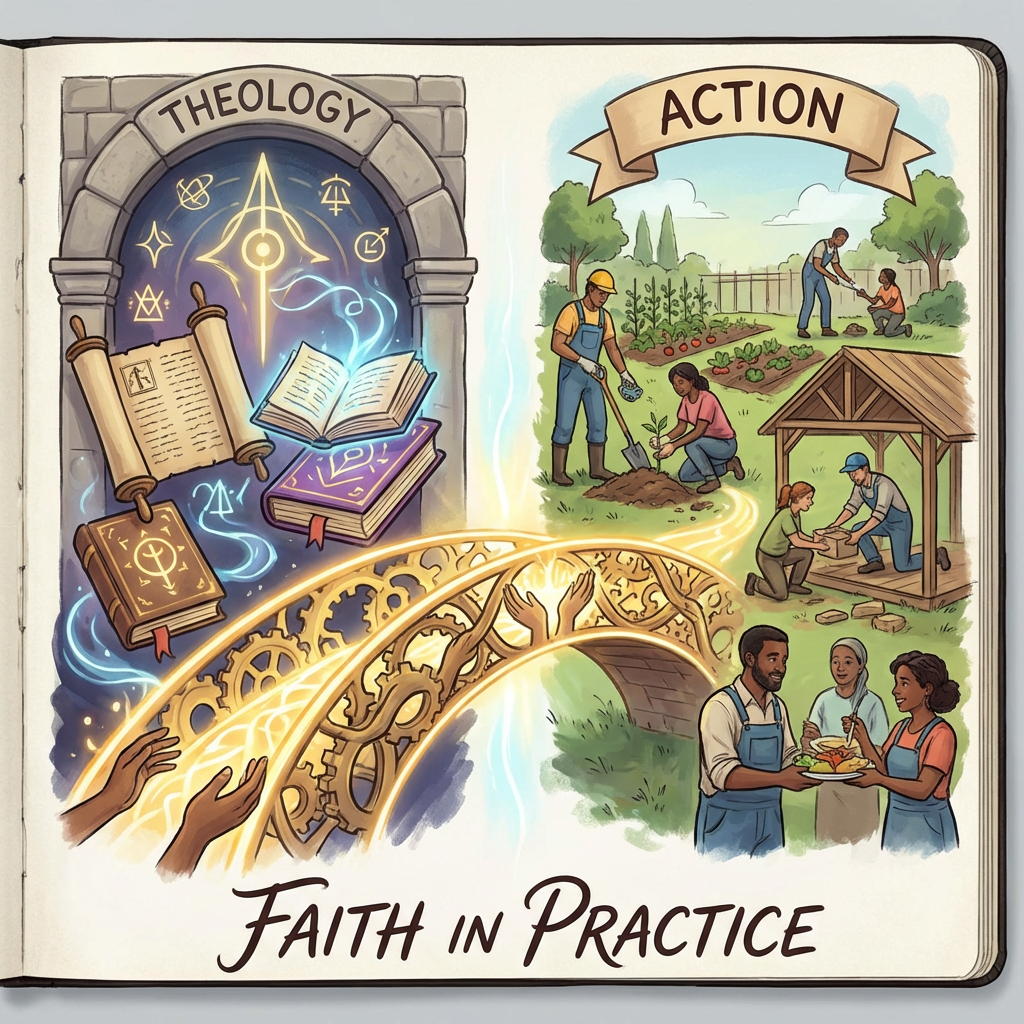
When I was working on my PhD, I felt like I might have lost my mind. I was seeing something so obvious, it felt like I must be wrong if nobody else was seeing it. It felt like the emperor was not wearing any clothes, and there seemed to be an unspoken agreement not to talk about it.
What I could not understand was an obvious and massive gap between what researchers (experts) were studying and what practitioners (users) needed and were begging for. Researchers wanted to write about cutting edge topics like blockchain applications in logistics. Practitioners needed answers for basic questions, like how to keep trained employees from walking out the door. Two completely different conversations happening in the same field, about the same people, at the same time. The people generating knowledge and the people who needed wisdom to live by were not talking to each other. And nobody seemed particularly bothered by that.
I have since realized the same gap exists between theology and the average person of faith. Unlike the gap in logistics research, this mismatch has consequences that cannot be ignored. We have eternity wagered on our understanding.
There is an abundance of absolutely extraordinary theological work out there. Augustine of Hippo built frameworks for understanding the nature of God that still hold up. Aquinas worked out the structure of moral reality with a precision most of us will never fully appreciate. C.S. Lewis translated many of their ideas into something to excite the imagination. Wes Huff is making theology accessible now in plain language, and people cannot get enough. The demand for his explanations is so high, it seems like a threat to consume him entirely. Not one of these individuals is infallible, but we can use their reasoning to advance our own.
There is not a pressing need for deep thinkers to re-invent and modernize the Bible. Good theology remains sound and holds up to scrutiny today. Current church schisms are not driven by a change in the Bible, but by changes in society driving us to modify our interpretations. Not that growth is bad, but it’s fair to question why we are rejecting hundreds, sometimes thousands, of years of thought. The current crisis in the Methodist church is an unfortunate and timely example. Softening the gospel to increase membership does not lead to growing our faith in Christ.
Society has progressively normalized sin and desensitized us to more extreme behavior and thoughts. The Bible tells us repeatedly that this will occur. 2 Timothy 3:13 says, “Evil people and impostors will go on from bad to worse, deceiving and being deceived.” Matthew 24:10-12 says, “many will turn away from the faith and will betray and hate each other, and many false prophets will appear and deceive many people.” 2 Timothy 4:3-4 goes on to say, “For the time will come when men will not put up with sound doctrine. Instead, to suit their own desires, they will gather around them a great number of teachers to say what their itching ears want to hear. They will turn their ears away from the truth and turn aside to myths.”
This Biblical pattern of increasing sin illustrates a need for clarity in how we interpret the Bible. The acceptance of subjective morality in our society, rejecting objective morality, underscores how badly we need a firm understanding of the Bible for application of objectively moral behavior. Our own individual ideologies cannot each be the most important collective issue, that’s not how reality works. The Methodist Church did not need to become affirming of the LGBT community to increase their Biblical grounding. It raises more questions than it answers in how to better lead people to Christ. The Bible teaches to love and accept, but not to affirm. Isaiah 5:20 says “Woe to those who call evil good and good evil,” acknowledging that there is a difference between the two. Affirmation is a modern addition to the theological lexicon that tends to change long held positions on what is considered good or evil. Cultural tolerance colliding with Biblical teachings doesn’t mean that we need new theology. It suggests that we need to know how to apply what the Bible tells us with love and grace.
Even the people who translated theological ideas for previous generations are difficult to understand today. Older books seem to assume things about their audiences that are no longer true. Society stopped prioritizing Biblical literacy, so that literacy can no longer be presumed.
Lewis assumes you are comfortable following a layered argument and sitting with metaphor. I have had friends try The Screwtape Letters and walk away baffled. Not because they did not care. Because the book’s prose, style, and format did not match the reader’s life. J.I. Packer is a more direct author, but he carries a tone that can feel like a lecture from someone who has already decided you are probably doing it wrong. We struggle to give the benefit of the doubt that someone who has dedicated their life to interpreting the Word may know more about the topic than we do, even if we have never cracked the Bible’s cover.
Jordan Peterson has compelling ideas, but he uses the most academic version of words and leaves them just undefined enough that his readers can feel special in their power to decipher his meaning rather than finding themselves submitting to Christ. We don’t need academic eloquence in discussing the possibility of God existing, we need direct language helping us understand how to live our lives according to the Word of God.
People today are not dumb, and Peterson raises genuinely interesting points. But how does a layman apply those thoughts? How do you take the musings of someone who will not affirm his faith in God and use that as a guide to discernment? The gap between the idea and the application is still there, and it’s huge.
A single mom working sixty hours a week is not going to sit down with Aquinas for some light reading. She may feel the need to sit down with a glass of chardonnay and some junk TV just to keep her sanity. I don’t blame anyone for the desire to decompress, but I do suggest that the things we do to unwind are not mindless. Passive influence is dangerous. There is advertising devised by psychologists to maximize your engagement and a cultural push towards consumerism. Businesses care about relieving us of the burdensome weight within our wallets, not the quality of the lives we lead.
Beyond that, our focus is spread across the globe. If we are focused on things happening around the world, we have very little energy to be engaged in our own community. With waning focus, we end up trying to take shortcuts by seeking wisdom from “experts” who seem to have found answers through experience.
People are not suffering from a lack of guidance. They are swimming in it. We are just not recognizing that guidance is not just a tool to use, it is something that is shaping us. Guidance from others is an active effort to change ourselves, moving towards an image of something we think we want to become. The question is not whether people are being formed. We are being formed constantly. Better questions are: by who or what are we being formed, and for what purpose?
Andrew Tate is telling young men how to live so the system doesn’t play them. Jordan Peterson is walking people in the direction of God without quite giving Him the glory or explaining how or why to follow. The entire self-help world has a gospel of its own; start with your why, optimize your time, level up, build your brand. The Kardashians have normalized viewing money and visibility as something to worship and pursue at any cost. None of that is neutral. Every one of those voices is giving their own answer to the same question: what does a good life look like, and what should you be chasing?
Why do we trust others to tell us what a good life looks like, but we don’t look for an answer from God?
We have a desire (a need, actually) to worship, and people will put things in front of us to worship that also happen to line their own pockets. It is discipleship, whether anyone is comfortable naming it or not. Normal people are willing to spend time and money for answers, as long as it doesn’t require real change, work, or submission. The expert researchers end up selling snake oil that they claim worked for them.
Some of it seems legitimate, at least in the short-term. That is why the demand spreads. These practical ideas seem to address real desires. Money. Respect. Belonging. Purpose. Security. It gives people something concrete to do tomorrow. The problem is that almost none of this type of help stops to ask whether you are pointed the right direction before it helps you go faster.
Starting with your own “why” assumes you already have the correct starting point. Leveling up assumes you know what you are reaching for. Optimizing your time assumes you already know how best to spend your time. Those are enormous assumptions to skip over.
Augustine talked about ordered loves. The idea that your actions flow from your desires, and if your desires are pointed at the wrong things, getting better at achieving them just makes things worse. I have seen people build successful careers at the cost of their marriages. I have seen others put their children’s satisfaction before the health of their own marriage. The system called one winning and the other good parenting. Scripture calls both being wise in your own eyes.
I spent years firmly inside the framework the modern world offers. Military, college, graduate school, a PhD program, senior-level positions. I learned practically and academically how the world explains reality. None of it felt intentional, it was just a growing evolution of plans. I would attempt to improve my station, re-assess if it worked or not, and move forward with a new plan to further improve my station. And after all of that personal effort, I encountered God’s mercy in a way that forced me to reconsider the entire framework itself.
A friend told me once that he understood where I am, spiritually, because he had been there. He had gone to church as a teenager, but asked harder questions in college, and then walked away from religion once he “woke up.” First Corinthians 13:11 says that when he became a man, he put the ways of childhood behind him. Somehow, for my friend, thinking and reasoning like a teenager was enough for him to conclude that faith did not work. He had inverted the verse entirely, and consequently, supported the world view he wanted to pursue. No need to submit to anything or anyone.
What often goes unexamined is how easily people assume they have given faith a fair evaluation. Trying church as a teenager and carrying a distaste forward for the rest of your life is a little like trying broccoli once as a child and deciding you dislike it forever. You do not have to keep trying it indefinitely, but it would be strange to say you carefully evaluated something if your only experience happened before you were fully formed. Sometimes something happens that shakes our faith, like experiencing a tragic loss and blaming God. If God existed, how could these bad things happen, especially to us? We lash out with blame, but how can we justify feeling like something was taken away if we don’t want to acknowledge that something was given in the first place? These ideas will require more room to unpack later. The point is that people feel justified in abandoning their faith, and I don’t presume it to be a decision made lightly in most cases.
The “how” of the decision to reject religion is less consequential than stopping to ask how often and how honestly we assess our worldviews. All of them. Christ included.
Jesus said, “Let the little children come to me and do not hinder them, for the kingdom of heaven belongs to such as these” (Matthew 19:14). We are called to have a childlike faith, but that does not relieve us from an obligation to be firm in our faith. Although some people have a simple faith that leads them to no further examination, I believe the obligation to examine world views exists for believers as well. If someone claims to follow Christ but has never wrestled with the difficult questions, their faith has probably never been examined very deeply. Jesus warns about shallow roots in the Parable of the Sower (Matthew 13: 5-6). If that is the state of your faith, I pray no wind comes your way.
I want to say something plainly; I don’t care about obscuring it for the sake of non-believers who might overhear. There is a fog in this life that is meant to distort, confuse, and mislead. It is manufactured to keep you from having a relationship with God. That fog is real, and it is genuinely hard to navigate. There are voices telling you how to live, and they are louder and less trustworthy than ever. But there is a compass. The Word of God. It is not a feeling or a tradition or someone’s interpretation of the cultural moment. It is written, it is tested, and it does not change.
In Knowing God, J.I. Packer says “people have gotten into the practice of following private religious hunches, rather than learning of God from His own Word.” Or as Josiah Queen sings, “we got dust on our Bibles, brand-new iPhones, no wonder why we feel this way.”
Most of us have not properly learned how to read, interpret, and apply the Bible. We don’t need a prescriptive program on how to follow Christ, we need to learn and practice discernment. That comes through reading the Bible, understanding what it means, spending time in prayer, and surrounding ourselves with fellow believers.
That is what I keep coming back to. Not the question of how to optimize your choices inside a game you did not pick, but how to practically improve our lives. How to discern if we are even playing the right game at all.
Researchers and practitioners in many academic fields talk past each other consistently. Theological experts and the people who need to understand their ideas are doing the same thing, a stubborn tradition carried out for centuries. I do not have Aquinas’s precision or Lewis’s literary gift. What I have is a complicated life that Scripture helps me understand in hindsight, and a genuine interest in closing the gap between the ideas and the people who need to live them.
If you believe in Christ, I hope this sharpens your thinking and gives you better language for what you already know.
If you do not believe, you are welcome in this conversation. You have value to God through Jesus Christ. I cannot manage the conversation only for your comfort, but I won’t pretend you are not here. If something in what you read here is uncomfortable, that is likely worth investigating. The door has never been locked from God’s side.
We are all following rules. Even the idea of ‘hacking’ systems to avoid rules has rules, ironically. There is no such thing as staying still. We have to move. It’s worth at least acknowledging the rule set in which we choose to operate.
I pray that I effectively use the Bible as the rules by which I live my life, and I pray the same for you. I look forward to the continued examination of those rules so we can better apply them. That will get us closer to God, and that is the real goal.
 CarlZunker.com
Leave a comment