I have learned by accumulating scar tissue over the years to pay attention to one important rule: Read the instructions all the way through before starting. If someone tells you that, there is likely a trick in store.
My kids were watching a TV show called Brain Games that explores cognitive processes. In this episode, kids were challenging parents in a game show type environment to prove who was more competent. To test themselves in listening, both parents and kids were given a set of written instructions and told to read them completely before they began.
The instructions contained a list of silly tasks. As soon as the round begins, the kids start working through the list as quickly as possible. They rushed through the instructions, completing humorous actions one by one because the kids assume the goal is to finish first.
When the parents took their turns, almost all of them did something strange. Instead of starting the list of silly tasks, they walk over to a small lounge chair, sit down, and begin eating cookies that were placed there. All while the kids run around the other side of the stage.
It looks like the parents didn’t care about the game at all. When the game ends, the instructions are shown to the audience. At the very bottom of the page was a final instruction telling all participants to ignore everything above and simply sit down and relax. The entire challenge rewarded the person who actually read the whole page before starting.
Most of us have seen some version of that trick before. Scavenger hunts sometimes do the same thing. The first instruction says to read the whole sheet before starting. The last instruction says to ignore everything else and do something simple.
The point is not intelligence. The point is understanding what the game actually is before trying to win it.
Sometimes it doesn’t feel like life gives us a printed instruction sheet.
Instead, there is pressure to begin moving. We are told successful people act quickly and make decisive choices. Careers must be chosen. Opportunities must be seized. Time must not be wasted.
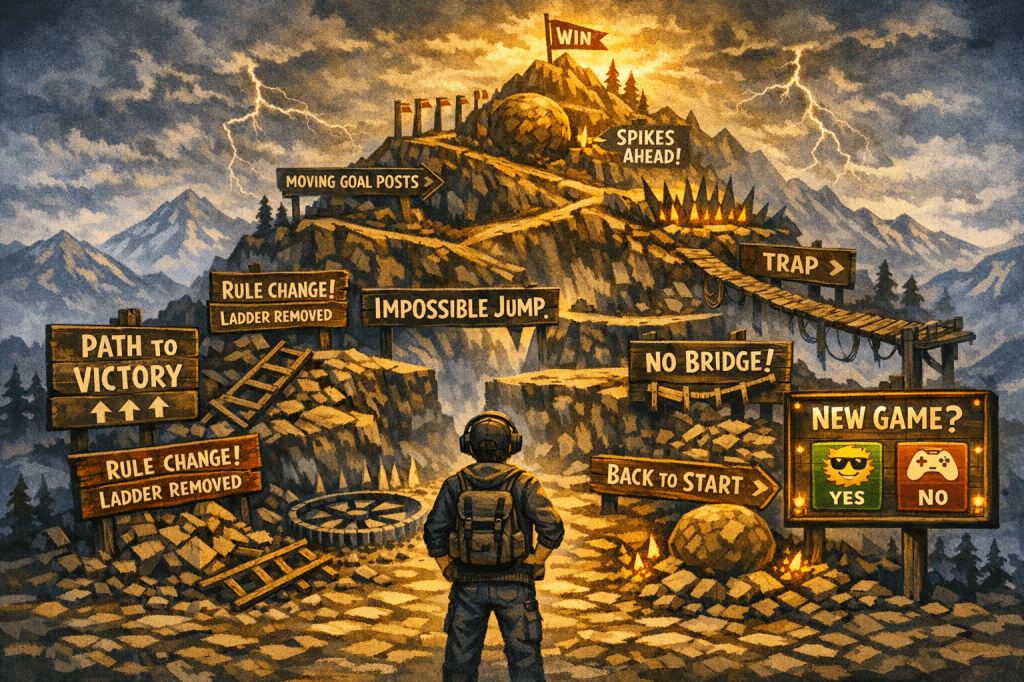
So, we begin optimizing. Should I pursue this career? Should I move here? Should I invest time in this skill or chase that opportunity? But these questions assume something that most people never stop to examine. They assume the system defining success is already correct. We assume we are playing the right game.
Every person operates inside of a kind of decision matrix. It determines what we count as success, what society counts as failure, what is worth pursuing, and what should be avoided. Our logic tree determines how we interact with reality.
People do not build that decision matrix or logic tree on their own. It gets handed to them in one way or another.
Parents shape early values. Schools define achievement. Employers define productivity. Culture defines status. By the time someone is making their own decisions, the framework those decisions sit inside has already been constructed.
People then spend years optimizing inside that system. They climb ladders, chase recognition, and pursue goals assumed to be meaningful because everyone around them treats those goals as meaningful. Agreeing to play by rules nobody truly examined is often called social proof or conformity in psychology.
Very few people stop to ask whether the system itself is pointed at anything true.
There is another difficulty here. Each of us only experiences life from inside our own perception. We cannot step outside ourselves to verify the structure we are reasoning within. We are using tools we were given inside a framework we did not choose.
And most people never notice.
Psychology offers some insight into why we rarely pause long enough to reconsider.
One reason is something called the sunk cost fallacy.
The sunk cost fallacy describes our tendency to continue investing in a decision because we have already invested in it. Time, effort, and identity become tied to the direction we started moving. Walking away begins to feel like admitting the earlier effort was wasted.
In theory the past should not matter. The only rational question is what decision produces the best outcome going forward. In practice people rarely operate that way. They reinterpret the situation so continuing forward feels justified.
Another force at work is something called the endowment effect.
The endowment effect describes our tendency to value something more highly simply because it belongs to us. Once we own something, or once a decision was ours, we begin to treat it as more valuable than we would if we were evaluating it from the outside.
My family and I lived these psychological lessons the hard way through a seemingly simple decision I made. All I had to do was not listen to my wife.
Each year my wife and I try to take a trip together without the kids for our anniversary. One year we decided we wanted to go camping. We had talked before about getting a camper. I was strongly in favor of the idea. My wife was not. I had heard stories from other dads about how camping trips had drawn their families together and created great memories for their kids.
When we looked at the numbers, renting a camper for two weeks would cost about a third of the price of buying one.
The logic seemed obvious. Buy the camper, take the trip, and sell it later if it does not work out.
I made the decision; we bought it and took the trip. If you have ever owned a camper, you probably already know what happens next. The trip itself was great. We had an amazing time, and I highly recommend taking a camper to New Hampshire for two weeks if you are given the chance. But after that first trip, life got busy and the camper sat mostly unused.
After a few years of disuse and neglect, it came time to sell the camper. That was when another dose of reality arrived. I wanted to get close to what I had paid for it, so I did not feel like such a sucker, but the market did not care what I had paid. The resale value simply was not there.
At that point the choice became clear. I could sell it for what it was worth or hold onto it out of stubbornness while it slowly deteriorated further.
What made that decision uncomfortable had nothing to do with the camper itself. It had to do with my attachment to the decision that bought it.
As a student of psychology, I understood all of these ideas before we bought the camper. I then struggled to process my emotions about the psychology after the milk was spilled (or the camper was bought, in this case). And please remember, this is a camper we are talking about, not my identity as a person. I still let my ego drive decisions over a few thousand dollars.
What happens to this pattern when we apply it to something larger? Would it make sense that we are less stubborn when the stakes are higher, or would we hold on tighter to what we want to believe? What happens when we apply these principles to how we think about religion?
What if there were a set of instructions for life? What if we recognized that the Bible gives us everything we need? There are no tricks, but it is still best read completely before we jump into making decisions.
Faith is often dismissed as emotional or irrational. The assumption is that religion is something people adopt because it feels comforting while skepticism represents the more rational position.
Psychology complicates that assumption. I argue that philosophy, history, math, and many other subjects complicate that assumption, but we will stay with psychology for this discussion.
If the sunk cost fallacy and the endowment effect are real, then human beings naturally defend the worldview they already inhabit. Some could argue that these effects are not universal, not “provable” in a meaningful way, or not applicable across the board. I don’t disagree, but it would be difficult to find anything that applies across 8 billion humans perfectly, so we must operate within some confines.
We have to generalize, but generalizations can bleed into areas where they don’t quite fit.
A friend once told me he understood where I was spiritually, he understood my faith, because he had been there before. He had gone to church when he was younger. When he went to college, he started asking harder questions and eventually walked away from religion. He took his general experience, and with no context, overlayed it on mine. His reasoning as a kid outweighed my reasoning as an adult.
1 Corinthians 13:11 says, “When I was a child, I talked like a child, I thought like a child, I reasoned like a child. When I became a man, I put the ways of childhood behind me.” Somehow, thinking and reasoning like a child was enough for my friend to determine religion didn’t work for him, so it could not work for me either. He did not even recognize that he had inverted the verse about leaving childish things behind.
My own path moved in the opposite direction.
I had also been around church when I was younger. Later I spent years living conveniently inside the framework the modern world offers, the one I was handed and built upon myself. Through my time in the military, attending college, graduate school, and eventually a PhD program, I learned practically and academically how the world explains reality. After spending years inside those systems, I experienced God’s mercy in a way that forced me to reconsider the framework itself. I finally understood the instructions.
Both my friend and I believe we have examined the issue honestly, but instead of putting effort into asking questions, he put his effort into defending his own position.
What often goes unnoticed is how easily people assume they have given religion a fair evaluation. Someone may attend church as a teenager, decide they do not believe it, and carry that conclusion forward for the rest of their life.
That is a little like trying broccoli once as a child and deciding you dislike it forever. You may not have to keep trying it, but it would be strange to say you carefully evaluated it if your only experience happened decades earlier before you were fully developed with any life experience.
While the Bible embraces simple faith, such as in Mark 10:15 and Matthew 18:3, becoming like little children does not mean we do not ask questions. What some believers may not enjoy hearing is that the same responsibility to understand exists on both sides. When my kids were little, their favorite question was “why?” Like 1 Peter 3:15 says, we need to be prepared to give an answer when someone asks for the reason for the hope you have. “Because I said so” did not satisfy my kids, and it probably won’t satisfy a non-believer either.
If someone believes religion has no value, the honest approach is to engage the strongest arguments Christianity offers. Books like Mere Christianity by C. S. Lewis attempt exactly that. A book like The Drama of Scripture shows how the Bible fits together as a coherent story. Works such as The Case for Christ or Cold-Case Christianity examine the historical claims about Jesus.
Christians face the same obligation to understand their own position. If someone claims to believe but has never wrestled with the difficult questions surrounding faith, that belief has likely never been examined very deeply. The danger is shown in Mark 4:16-17 (NIV), “Others, like seed sown on rocky places, hear the word and receive it with joy. But since they have no root, they remain only a short time. When trouble or persecution comes because of the word, they quickly fall away.”
The instructions are clear. Know the Word. If you rely on simple faith alone, I pray no wind comes your way to test your roots. We need to come to Christ like children, and children ask questions. I want to read all the instructions before I ask him about what I do not understand.
The lesson from the kids TV show applies to both sides of belief. We need to ask why we are doing what we are doing. You can work very hard and still miss the point if you never read the whole page.
Psychology suggests we naturally defend the systems we already inhabit. The sunk cost fallacy keeps us moving in familiar directions. The endowment effect convinces us that the choices we already made must be valuable simply because they were ours.
All of that makes it difficult to pause long enough to ask a simple question.
Not how to optimize your choices in a game you didn’t pick, but whether you are playing the right game at all.
 CarlZunker.com
Leave a comment