There is a practical element to the teachings of Jesus in Matthew 5 regarding the fulfillment of the law. Jesus is clearly saying that we have underestimated the meaning of laws against murder and adultery as examples, although his teaching can be extrapolated further. These sins (murder and adultery) are not a ceiling we must not break through, but they are a floor that seems to be where we fall when we allow sin to grow. He then expands further to divorce, oaths, vengeance, and love for our enemies, but again, we can continue the application of being called to more for all the commandments. Following the letter of the law is not enough. Jesus has already fulfilled the letter of the law. We must follow what the law means, not just what it says.
Jesus highlights man’s understanding of the law in Matthew 15:3-12. The major point is held in verses 8 to 9, “These people honor me with their lips, but their hearts are far from me. They worship me in vain; their teachings are merely human rules” (NIV). Our application of the laws against murder and adultery is insufficient. Matthew 5:21-22 says, “You have heard that it was said to the people long ago, ‘You shall not murder, and anyone who murders will be subject to judgment.’ But I tell you that anyone who is angry with a brother or sister will be subject to judgment. Again, anyone who says to a brother or sister, ‘Raca,’ is answerable to the court. And anyone who says, ‘You fool!’ will be in danger of the fire of hell” (NIV). Raca is an Aramaic term of contempt. Anger and contempt are the same type of sin as murder, although to a lesser degree. If the speed limit is 55 miles per hour, we cannot with certainty say that we will not drive 100 miles an hour while we are cruising along at 70. Many non-believers have stated that they are “good” people, and why would God judge them if they have not sinned (such as committing murder or adultery). We must accept that having anger or looking at a woman lustfully is sin, even if we have not murdered or cheated on our spouses.
The growth of sin is clearly illustrated in the story of David and Bathsheba in 2 Samuel 11. The growth of sin started with David remaining home while his army was at war and escalated to the murder of a man whose wife David impregnated. Pope Gregory 1 (in the 6th century) helped popularize the understanding of the seven deadly sins (based on the work of Evagrius Ponticus, a 4th-century Egyptian monk) as pride, envy, wrath, sloth, greed, gluttony, and lust. David started with sloth. Then he moved to lust. His lust led him to covet the beautiful Bathsheba. When he slept with her, she became pregnant. David tried to have her husband (Uriah the Hittite) come home and sleep with Bathsheba so there was plausible deniability in who the father was. Uriah refused the comfort of his wife because none of the other soldiers got the comfort of lying with their wives. After several attempts at tricking Uriah failed, resignation set in for David. He could not own the consequences of his actions, and his pride led to ordering her husband to be put in a position to be killed in battle. Murder. What started with sloth, which may not feel like an overt sin, led to a violation of God’s explicit commandments.
To demonstrate what Jesus said in Matthew 5, here is an illustration that lets us visualize His words:
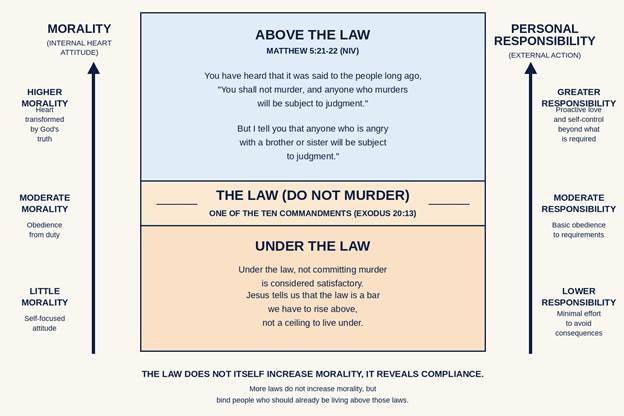
While laws may guide the regenerate heart toward righteousness, they do not increase morality. Laws reveal compliance. Understanding the meaning of God’s laws lets a transformed heart act with greater morality and increased personal responsibility. When we live under the law, we can have a self-focused attitude that allows us to operate with a lower level of morality. There is also a lower level of personal responsibility, requiring just enough effort to avoid obvious consequences. If I do not want to go to jail, I do not commit murder. I know I can speed 5 miles per hour over the limit without getting pulled over. It’s still breaking the law, but at a level where there should not be significant consequences. But at a high level of morality, we operate with a heart transformed by God’s truth. We bear the yoke of greater responsibility to practice proactive love and self-control beyond what is required to fulfill simpler interpretations of the law: stop short of murder. The question becomes: Do we observe the small sins stacking up? And what do we do when we make that observation?
Another example is Cain and Abel. Cain’s offering was not accepted, but Abel’s sacrifice was looked upon with favor from the Lord. In Genesis 4:6-7 the Bible says, “Then the Lord said to Cain, ‘Why are you angry? Why is your face downcast? If you do what is right, will you not be accepted? But if you do not do what is right, sin is crouching at your door; it desires to have you, but you must rule over it’” (NIV). Cain was jealous of his brother. Sin was at the door, crouching, desiring Cain. Cain had every opportunity to turn to God and do what was right. Cain entertained the small sin of anger instead, and it grew. He took his anger and used it to murder Abel.
The difference between David and Cain is significant. Cain lamented the discipline he received, while David eventually accepted consequences. David repented and wrote a prayer for forgiveness after he was confronted by the prophet Nathan about his sin with Bathsheba. In Psalm 51, verses 16-17, David says, “You do not delight in sacrifice, or I would bring it; you do not take pleasure in burnt offerings. My sacrifice, O God, is a broken spirit; a broken and contrite heart you, God, will not despise” (NIV). In Genesis 4:13-14 it is written, “Cain said to the Lord, ‘My punishment is more than I can bear. Today you are driving me from the land, and I will be hidden from your presence; I will be a restless wanderer on the earth, and whoever finds me will kill me’” (NIV). Cain did not repent; he was afraid of the consequences of his action. David offered a broken and contrite heart. God did not despise David’s offering.
When I consider these stories, I ask myself why they didn’t stop before adultery and murder. Then I think of my own life, and I know that I have entertained what I perceived to be “small” sin. I can control it when it’s only 5 miles an hour over the speed limit. Small sin leads to larger sin; it grows as we feed it. Having anger in our heart is as much a sin as murder is, even if it seems to be on a smaller scale. We are told repeatedly that small sin grows. James 1:14-15 says, “but each person is tempted when they are dragged away by their own evil desire and enticed. Then, after desire has conceived, it gives birth to sin; and sin, when it is full-grown, gives birth to death” (NIV). When we see ourselves sinning, when we see ourselves angry or lusting after a woman, that is the time to repent and take it to God. It doesn’t mean we have not sinned, because each of us is a sinner, but we do not need to let sin give birth to death.
In the secular world, the threshold for what is considered a sin is constantly moving in the wrong direction. We can either accept the world’s teaching that satisfying our flesh is not a sin, or we must acknowledge that God knows us. Psalm 139:1-2 says, “You have searched me, Lord, and you know me. You know when I sit and when I rise; you perceive my thoughts from afar” (NIV). We can tell ourselves that we are good, but who has never been angry in their life? Who has never lustfully looked upon another person? In the history of humanity, there is only one, and He came to us as our Savior. Our sin may not be as great as murder, but it is still sin. The world wants us to hold our sins on our laps and stroke them like a beloved pet. It pleases the flesh to indulge. Just 5 miles an hour over the limit. Jesus is calling us to notice and to repent. He is calling us to change.
Just because we think we have not broken a commandment does not mean we have not sinned. If we understand what it means for Jesus to have fulfilled the laws and called us higher, we cannot help but see our wickedness more clearly. I don’t intend this missive to be condemnation, but I do hope it sparks conviction. Submitting to God does not lead to a sin-free life. Anselm of Canterbury once said, “You have not yet considered the great weight of sin.” If we do not consider our sin, we can ignore it, or more likely, we can justify it. Recognize the weight of sin, account for it, seek the Lord to ask forgiveness, and do your best to not relapse. Conviction is a powerful force that drives belief and forces action. Let conviction do its work in you to drive you toward who Christ is calling you to be.


Leave a Reply